Overview:
Having loose teeth as a child is okay but as an adult it should not be ignored? So if you also have a loose tooth and are wondering why your teeth feel loose or can these be treated without removing them, then don’t worry if diagnosed early you can stabilize your tooth.
This blog will guide you about tooth mobility, its symptoms, causes, loose teeth treatment, and how you can prevent loose teeth.
What is Tooth Mobility?
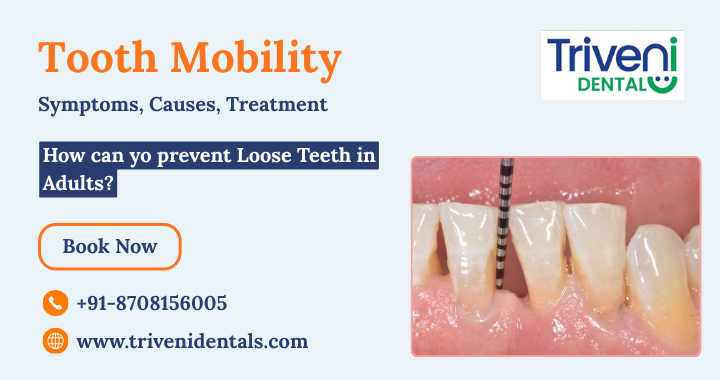
Movement or loosening of a tooth in its socket beyond the normal range refers to tooth mobility. Loose teeth in adults are not normal beyond a range, tooth mobility is occurring due to some periodontal disease, trauma or too much bone loss.
Symptoms of Tooth Mobility
Loose teeth just feel off or different during eating or brushing. Below are some of the symptoms of tooth mobility:
1. Tooth appears bigger in size
2. Gums recession
3. Pain or discomfort while chewing
4. Teeth feel loose while biting or brushing
5. Tenderness/Redness or swollenness in gums
6. Sensitivity in teeth
Tooth Mobility Causes
Wondering what causes loose tooth in adult, below are some of the causes of tooth mobility:
Gum disease is the most common cause of loose teeth as these if left untreated slowly break down the bone supporting the teeth.
b) Trauma or Injury
An accidental fall or sports related injury on the mouth causes teeth loose due to damage in the jawbone.
c) Teeth Grinding (Bruxism)
Some people have a habit of teeth grinding which causes teeth mobility over time due to excessive pressure on teeth and their supporting structure.
d) Pregnancy
Hormonal changes during pregnancy cause looseness in the tissues which hold teeth, but this is temporary after childbirth these symptoms will go away on their own.
e) Bone Disease
Sometimes bone disease like Osteoporosis makes the bone lose mass which causes instability in teeth.
Tooth Mobility Classification (Grades of Tooth Mobility)
MILLER’s classification of tooth mobility is used generally by dentist while classifying tooth mobility:
a) Grade 0: This is non detectable mobility or can be seen as normal teeth movement.
b) Grade 1: Movement in horizontal direction less than 1 mm.
c) Grade 2: Moderate mobility in horizontal direction more than 1 mm but no vertical movement.
d) Grade 3: Severe mobility with both horizontal as well as vertical displacement.
Tooth Mobility Treatment / Loose Teeth Treatment
Loose teeth treatment totally depends on your condition as well as what is the root cause of loose teeth. Your dentist after examining cans suggest you any of the below teeth mobility treatment option:
1. Teeth Scaling and Root Planing
If your teeth are becoming loose due to gum disease, then through deep teeth cleaning removing tartar and plaque buildup is the first step to make gums healthy again.
2. Splinting
In the splinting treatment your loose tooth will be bonded together with neighbouring teeth to provide it extra support while it is healing.
3. Bite Adjustment
In this a small amount of enamel will be removed from the loose tooth as well as from its neighbouring tooth to balance the bite by removing excess pressure.
4. Night Guards are advised to the patients who have a habit of teeth grinding so that there will be less pressure on teeth.
5. Periodontal Surgery
If periodontal bone is in good shape then flap surgery or bone grafting are also advised.
6. If there is advance mobility then tooth extraction is advised and can be followed by dental implant, dental bridge treatment to treat the missing tooth.
What Happens if Tooth Mobility is Ignored?
If tooth mobility or loose teeth will be ignored then it will lead to complication like:
a) Continuous bone loss
b) Too much pressure on neighbouring teeth
c) Bite issues or problem
d) Difficulty in chewing
e) Severe gum infection
f) Loss of teeth
Early diagnosis and treatment will help in saving your teeth and prevent complications.
Can You Prevent Loose Teeth?
Yes, by maintaining proper oral hygiene we can prevent loose teeth. Below are some preventive measures:
1. Try to avoid smoking or vaping.
2. During sports time try to wear a mouth guard.
3. If you have a habit of tooth grinding then use night guards.
4. Regularly visit your dentist for a checkup
5. If you have symptoms of gum disease then don’t leave these untreated.
6. Maintain proper oral hygiene by brushing and flossing regularly.
In adults loose teeth are normal or not?
No, in most cases as an adult if you have loose teeth these are not normal.
But if you have a little bit of mobility then it is common and not serious but if by touching you can feel that your teeth are moving then see your dentist.
Can a loose tooth become tightened back again?
Yes. If you have tooth mobility and it is diagnosed at early stages then loose teeth can become firm again by taking proper treatment like scaling, root planing, splining, or periodontal treatment.
Loose Teeth Treatment in Bhiwani at Triveni Dental
Having loose teeth and looking for Teeth Mobility treatment in Bhiwani? At Triveni Dental we provide affordable and best treatment for loose teeth from the experienced dentist. Treatment options include splinting, deep cleaning, Root Planing, Flap surgery and more based on your teeth condition.
Conclusion
As a child, tooth mobility is common but if you are an adult and facing a loose tooth problem then don’t overlook it and visit the dentist near you to avoid any further complications like tooth loss, severe gum infection and more.
Explore Similar:
Do natal teeth fall out on their own?
Wisdom Teeth Removal: When Is It Necessary vs. Optional?
Afraid of Dental Implants? Lessons from Ganesh Ji's story
हिलते हुए दाँतों का इलाज करवाने के बाद क्या करें और क्या न करें? | Dental Splinting