Overview
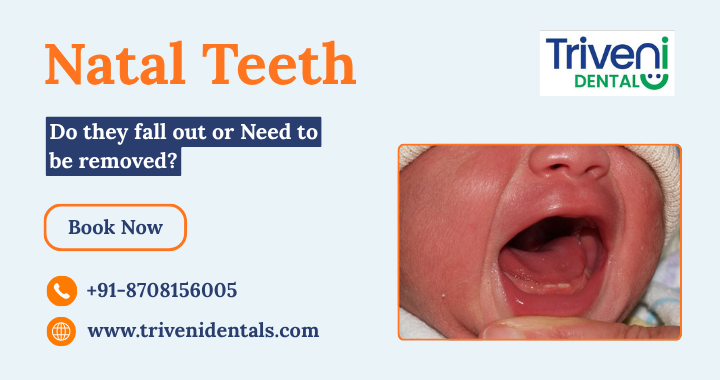
Imagine your baby is just born and you notice a baby tooth or sometimes two, these are called natal teeth, you will get a shock. Baby teeth don't appear until several weeks after birth.
Then parents have many questions: is this normal? Do natal teeth fall out or need to be removed? And some people think babies born with teeth are lucky.
In this blog we will let you know everything about natal teeth, what they are, what causes natal teeth in newborns, whether they are safe, and what is the right treatment for natal teeth.
What are Natal Teeth?
Natal teeth are teeth which are presented in a baby's mouth already at the time of birth. These are usually in pairs, small in size and central teeth in the lower jaw, but different from the regular baby teeth.
There is also a clear difference between natal and neonatal teeth, Natal teeth are present at the time of birth while neonatal teeth come within 30 days of baby birth.
How rare are Natal Teeth?
Generally parents and other people also get shocked when they hear that a baby is born with teeth, as these are rare. According to research, natal teeth are present in approximately 1 out of every 2,000 to 3,000 births. So that’s why this is an unheard concept and people think it is rare. But you can visit any dentist or doctor who is well equipped to handle it.
What causes Natal teeth in newborns?
The exact natal teeth causes are not clear, but according to research below are some of the causes:
1. Genetics or Family History: These run in families, if parent or sibling had natal teeth then chances increased or these might also be genetic disorders.
2. Infections: Congenital syphilis could lead to an increased chance of the occurrence of natal teeth.
3. Endocrine Disorders: An overactive thyroid, pituitary, or other glands might cause the chances of a child having natal teeth to rise.
4. Chemicals: An infant's exposure to specific hormones-disrupting chemicals could lead to higher odds of natal teeth being present.
Natal Teeth - Is it good or bad?
This is the most asked question by parents, and the answer is neither natal teeth are good nor bad it totally depends on the case.
The classification of natal teeth as either beneficial or harmful based on several important points:
a) Are these teeth stable or loose? If loose then these may pose a choking danger if by chance the teeth fall out.
b) Are they problematic during nursing? The teeth could hurt the mother or cause the child pain due to their sharp edges.
c) Is there a connection between these teeth and another syndrome? In this case, attention will be necessary.
When natal teeth are healthy, correctly aligned and asymptomatic, they can often be just kept monitored by the dental professionals rather than merely home monitored or monitored based on hearsay.
Natal Teeth Myths
Let’s break some of the myths related to Natal teeth:
Myth: Natal teeth are a sign of good luck.
Fact: There is no scientific basis for this logic. It is just a cultural belief in many societies that natal teeth are lucky but it is just a dental variation that needs proper attention.
Myth: Natal Teeth are permanent teeth of a baby.
Fact: These are extra teeth which are present at the time of birth and not the permanent teeth of a baby. Removing these does not affect the occurrence of permanent teeth.
Myth: Natal Teeth need to be removed.
Fact: This is not true. Whether the natal teeth need to be removed or not will totally depend on how firm they are, causing feeding problems or not and other factors.
Myth: Natal Teeth will fall out on their own.
Fact: Some natal teeth may fall out — especially if they are very loose. However, to leave it to chance is not a good idea. A loose natal tooth can potentially pose a serious choking hazard, and require professional evaluation.
Natal Teeth Treatment
The treatment of natal teeth totally depends on case to case by a dental expert. Below are some of the steps involved in it:
a) The dentist will examine the tooth and will check if it is loose or how firm it is.
b) If the tooth is firm, causing no feeding problems, & posing no choking risk, it can just simply be observed over the time.
c) If the tooth edges are sharp, then the dentist will just smooth these and do not remove the tooth.
d) If the tooth is loose, causing ulcers and also interfere with breastfeeding then tooth extraction is recommended.
Natal Teeth assessment and treatment in Bhiwani at Triveni Dental
If your baby is born with teeth, then don't panic or believe in folklore, just visit a dentist.
At Triveni Dental, we have experienced paedodontist who handle the natal and neonatal teeth syndrome with proper care and treat these effectively. We guide the parents in proper manner from X-Ray assessment to extraction if necessary.
FAQ
1. Are Natal Teeth lucky?
It is just a cultural belief and there is no science behind this. According to research natal teeth are neither lucky nor unlucky. What is more important is that these should be properly assessed by a dental professional.
2. Do natal teeth fall out on their own?
Natal teeth will fall out or not depending on how firm or loose these are. If these are loose these will fall out but if too much then they can pose a choking like situation.
3. Do natal teeth need to be removed?
It isn’t true that natal teeth must always be removed. The decision to remove a natal tooth must be made by considering its firmness, whether or not it would create feeding difficulties and so on.
4. What is the difference between natal and neonatal teeth?
Natal teeth are present at the time of birth while neonatal teeth occur within the first 30 days after birth.
5. Can natal teeth make breastfeeding uncomfortable?
Natal teeth may cause discomfort while nursing — for both baby and the mother. The baby may also develop Riga-Fede syndrome, which refers to tongue ulceration due to consistent irritation caused by the teeth. In case feeding becomes difficult, a dentist may help and either polish the tooth’s edges or suggest removal.
Explore Similar:
बच्चे के मुंह में जन्मते ही दाता आना 😱 घबराएं नहीं-पहले यह जानें!