Failed Root Canal Treatment (RCT)
Having root canal treatment but facing infection or severe pain on treated tooth after sometime? This situation is known as a failed root canal treatment, but chances of it are very low as generally Root Canal Treatment (RCT) is a successful treatment.
So if you are also facing the same problem and want to know, can Re-RCT be done?, is it better than removing teeth, its success rate and benefits, then this blog will guide you.
What is Re Root Canal Treatment?
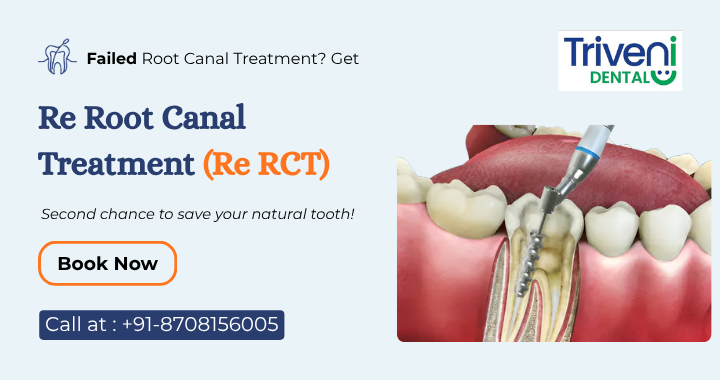
Re root canal treatment, also called Re RCT, is a dental procedure in which the dentist will reopen the treated tooth to remove the infection, by cleaning the root canal (old filling material is removed), disinfecting and sealing these again so that it can be saved from extraction.
Why did the initial Root Canal fail?
Dentists are often asked why the initial root canal fails even after treatment? Generally RCT is successful treatment, below are some reasons for failed root canal treatment :
1. Some canals that are hidden during the first treatment can cause the infection
2. Broken tooth crown or leakage of tooth filling will make place for bacteria to enter in the treated tooth and cause infection.
3. Complex root canal will make it difficult for the dentist to clean all the root canal during first RCT as some will be hidden
4. Hairline fracture on tooth which are less visible will cause infection in tooth
5. New decay or deep cavities can form around the treated tooth
6. Sometimes delayed placement of the tooth crown also makes a path for bacteria to re enter into the tooth.
Signs indicating you need Re RCT
If you observe the below signs and your dentist recommend re root canal treatment (RCT):
a) Continuous pain and discomfort even after RCT or after sometimes of it
b) Swelling around the treated tooth causing formation of a small pimple like bump on gums (known as sinus tract)
c) Discolouration of treated tooth (it become darken in colour)
d) Bad taste in mouth along with too much sensitivity to hot or cold
e) Returning of infection near the treated tooth
Is re root canal treatment safe?
Yes, re root canal or Re RCT is a safe procedure when done by an experienced dentist. It is done when the initial root canal treatment fails by removing the new infection from the root canal to save the tooth from extraction. If your RCT fails then don’t worry you can get a Re RCT and your natural tooth will be saved for many years.
Re Root Canal (RCT) Procedure
When you are visiting the dentist for re RCT, you can expect below steps:
1. Firstly your dentist will take an X-ray to examine your tooth condition.
2. Then you will be given local anaesthesia to make the procedure painless.
3. The dentist will remove the existing tooth crown to get access to the root canal.
4. Then your dentist will remove the old filling material and clean the infected root canal.
5. The dentist will place temporary filling and in the next appointment after the infection is cleared out will seal it with gutta-percha.
6. Later on a permanent crown is placed on the treated tooth.
Does Re RCT Better Than Removing the Tooth?
Yes, re root canal treatment is better than tooth extraction as:
a) It will save your natural tooth.
b) Improve your chewing ability along with preventing the neighbouring teeth from shifting towards the empty area.
c) It will also save you from costly treatment options like dental implants or bridges, done to replace the missing teeth after the extraction.
Tooth extraction is better only when it is impossible to save the natural tooth.
Re RCT Cost in India
The cost of Re RCT is generally dependent on severity of infection,dentist experience and tooth cap charges are extra. Re RCT cost in India ranging from Rs. 5000-11000 based on complexity of case, dentist experience and clinic location.
Re Root Canal Therapy Benefits
Below are some of Re RCT benefits:
1. Save the natural tooth
2. Relief from the severe tooth pain
3. Prevent the infection from spreading
4. Affordable option in comparison to replace missing tooth after extraction
5. Enhance the chewing ability
Re Root Canal Treatment Cost in Bhiwani at Triveni Dental
If you are searching for Re RCT in Bhiwani and want to know about Re RCT cost in Bhiwani then your search ends here. At Triveni Dental we provide safe and painless Re Rct treatment in Bhiwani, it costs around Rs. 6000, can cost extra if crown is placed and recommended by your dentist.
Best Re Root Canal Treatments Doctors In Bhiwani
Choosing the expert dentist for Re root canal treatment is very important as it will decide the chances of success of Re RCT.
Dr. Jaya Sharma at Triveni Dental is one of the Best Re Root Canal Treatments Doctors In Bhiwani, she is BDS, MDS with PGC Root canal Specialist and Cosmetic Dentist .
Conclusion
A failed root canal treatment doesn’t mean that you have to go for tooth extraction. With re rct treatment, the natural tooth can be saved by removing the infection from the tooth. So if you are having continuous pain even after RCT, then visit the dentist near you to get Re RCT.
But if looking for Re Root Canal treatment in Bhiwani, choose Triveni Dental, we provide safe and painless re RCT with best dentist for Re Root Canal Treatment in Bhiwani.
FAQ
1. Is Re RCT painful?
No, Re RCT is an almost painless procedure as it is done under local anaesthesia.
2. What is the Re root canal treatment success rate?
The success of the second or re root canal is approx 75-80%, depending on complexity of case and the endodontist experience.
3. Can a third root canal on the same tooth be possible?
A third root canal on the same tooth is possible but a complex procedure and its success rate is also dropped as root canal on the same tooth again and again will make the roots weak.
4. After failed root canal treatment can we get RCT again?
Yes, Re RCT can be done after a failed root canal to save your natural tooth.
5. Is the crown needed after Re RCT?
It is recommended to get a tooth cap after the Re root canal as it will support the treated tooth and prevent infection.
Explore Similar:
Root Canal vs Tooth Extraction: Which is the better choice for you?